From Gir & Sahiwal Milk to Bilona Ghee: How Mr. Milk Make Desi Cow Ghee?
Summary:
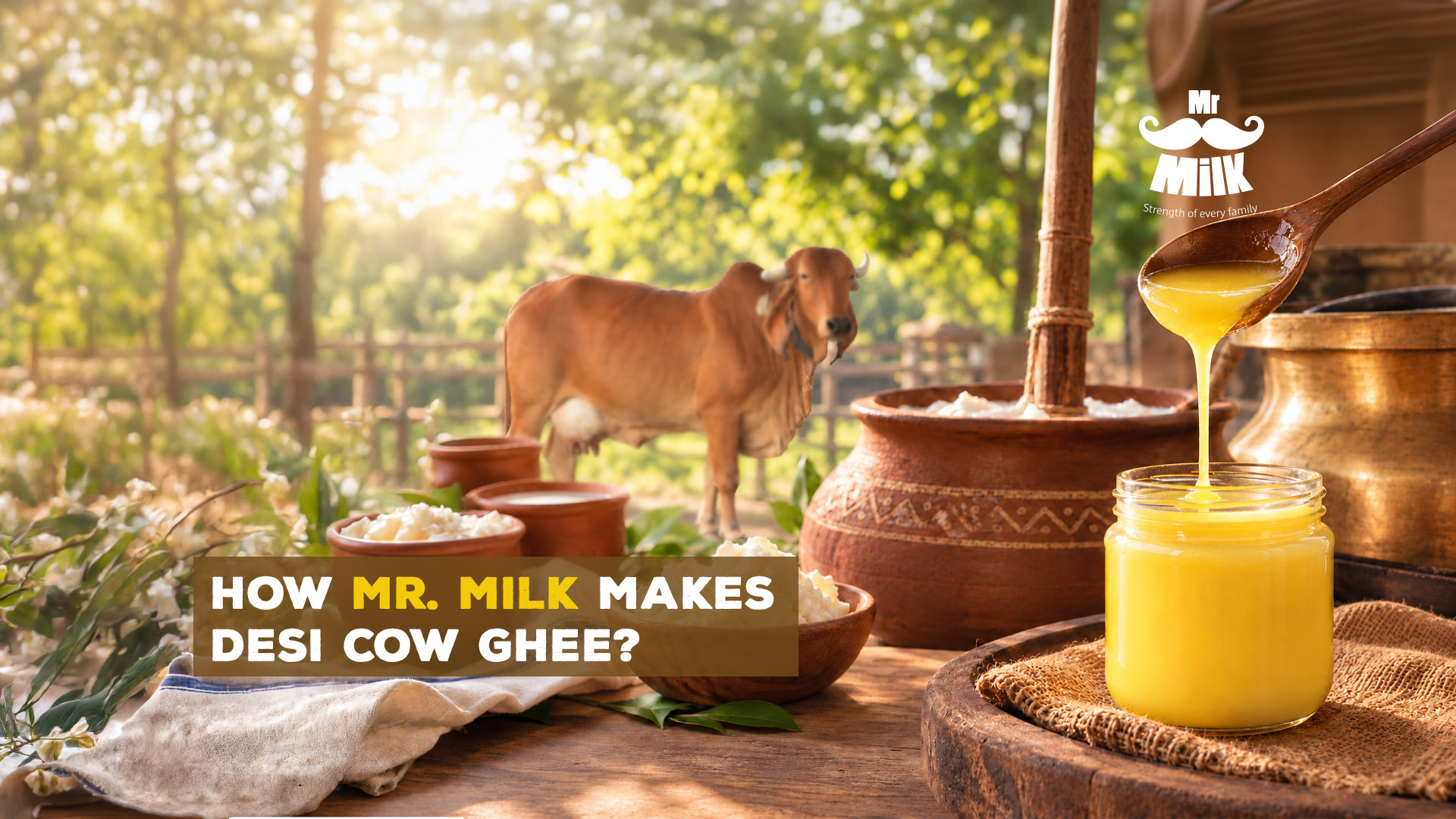
Mr. Milk crafts premium A2 desi cow ghee by combining ethical dairy farming with time-honoured Indian traditions. Starting with nutrient-rich A2 milk from indigenous Gir and Sahiwal cows, the milk is cultured into curd and churned using the authentic Bilona process. This gentle, slow-cooked approach extracts pure makkhan, preserving vital vitamins, healthy fats, and a distinct granular texture without any chemicals or additives.
Key Highlights:
Indigenous A2 Breeds: Sourced exclusively from ethically raised, grass-fed Gir and Sahiwal cows known for easy-to-digest A2 beta-casein protein.
Traditional Bilona Technique: Prepared by culturing milk into curd and wooden-churning it bidirectionally to retain natural aroma and essential nutrients.
Slow-Cooked Purity: Clarified over gentle heat to achieve a natural golden colour, rich granular texture, and high smoke point.
100% Pure & Unadulterated: Free from preservatives, synthetic hormones, or chemical processing from farm to jar.
Ghee has always had a special place in Indian kitchens. A spoonful over dal, a little on hot rotis, or a fragrant tadka can instantly make a simple meal feel more wholesome.
But not all ghee follows the same journey from milk to jar. Desi Cow Bilona Ghee is made through a traditional curd-to-butter-to-ghee process that takes more time and care than simply separating cream and clarifying it.
At Mr. Milk, that journey begins with indigenous cows and ends with small-batch Desi Cow Ghee made using the traditional Bilona method. The idea is simple: when you know where the milk comes from and how the ghee is made, you know much more about what you are bringing into your kitchen.
Where Does Mr. Milk Desi Cow Ghee Come From?
The first step in making good ghee is the milk itself.
Mr. Milk's dairy operation is based at Mittal Happy Cows Dairy Farm near Vadgaon-Maval, close to Lonavala, on a 150-acre farm. The farm focuses on indigenous Indian breeds, including Gir and Sahiwal cows, with an emphasis on animal care and transparent sourcing.
This farm-to-ghee connection is important. Instead of treating milk as an anonymous raw material, Mr. Milk traces the process back to the cows and the dairy farm.
The journey can be understood in five simple stages:
Indigenous Gir & Sahiwal cows
Naturally set curd
Traditional Bilona churning into butter
Slow clarification of butter into ghee
That is what gives Desi Cow Bilona Ghee its distinctive identity.
What Makes Desi Cow Bilona Ghee Different?
The biggest difference is not simply the word "Bilona" on the label. It is how the ghee is made.
Traditional Bilona preparation starts with milk, not cream. The milk is first converted into curd. That curd is then churned to separate butter, and the butter is finally heated slowly to make ghee.
This curd-based process is one of the defining characteristics of traditional Bilona Ghee.
It also explains why authentic Bilona ghee can have a distinctive aroma, richer flavour and naturally granular or danedaar texture. Texture can vary depending on temperature, crystallisation and processing conditions, so graininess by itself should not be treated as the only measure of quality.
How Does Mr. Milk Make Desi Cow Bilona Ghee?
1. It Starts With Desi Cow Milk:
Everything begins with fresh milk from indigenous cows.
For Mr. Milk, Gir and Sahiwal cows form an important part of its desi dairy story. The cows are cared for at the farm, and milk is collected as the foundation for the ghee-making process.
Good ghee starts with good milk. The source matters because the characteristics of the final product depend on the raw material used to make it.
2. The Milk Is Converted Into Curd:
The fresh milk is boiled, cooled and cultured to allow it to set into curd.
This is a crucial step because traditional Bilona Ghee is made from curd rather than directly from cream. Mr. Milk describes its process as a curd-to-butter-to-ghee journey carried out over approximately two days.
For anyone comparing ghee-making methods, this is one of the easiest things to check: ask whether the ghee begins with curd or cream.
3. The Curd Is Churned Using the Bilona Method:
Once the curd is ready, it is churned traditionally to separate the butter.
Mr. Milk uses a wooden Bilona churner for this stage. The churning process separates makhan, or butter, from the buttermilk. The brand's process information states that a batch can take around 45 minutes of churning.
This is where the traditional method demands patience.
There is no shortcut from curd directly to finished ghee. The butter has to be extracted first.
4. The Butter Is Slowly Heated:
The freshly separated butter is then gently heated so that its moisture evaporates and the milk solids separate.
Mr. Milk describes slow cooking as the next stage of its process, allowing the butter to gradually transform into aromatic golden ghee.
This slow clarification is also responsible for much of the sensory character people associate with traditionally made ghee-the warm aroma, rich flavour and characteristic golden appearance.
5. The Finished Ghee Is Tested and Packed:
After preparation, the ghee is filtered, packed and subjected to quality checks.
Mr. Milk states that its ghee batches undergo laboratory testing for quality and food safety and are made without added preservatives, colours or artificial flavours.
The finished Desi Cow Ghee is then packed for delivery, taking the journey from farm and traditional preparation to the family kitchen.
What Are the Benefits of Desi Cow Ghee?
When people search for the benefits of Desi Cow Ghee, they often expect a long list of health promises. A more useful way to look at it is to understand what makes a traditionally prepared ghee suitable for everyday Indian cooking.
Desi Cow Ghee can be valued for:
Its rich, naturally buttery aroma and flavour
Its versatility for tadka, sautéing and everyday cooking
Its suitability for traditional Indian recipes
Its long shelf stability when stored correctly
Its connection to a traditional curd-to-butter-to-ghee preparation
Its ability to add richness to simple foods such as dal, khichdi, rice and roti
Like any cooking fat, ghee is energy-dense, so the quantity used should fit an individual's overall diet and nutritional needs.
The real advantage of choosing a traditionally prepared product is knowing what went into making it, where it came from and how it was processed.
How Can You Identify Good Desi Cow Bilona Ghee?
If you are searching for the best desi cow ghee in India, the label alone should not be your only deciding factor.
Instead, look for clear answers to these questions:
Which cow breeds provide the milk?
Where is the milk sourced from?
Is the ghee made from curd or cream?
Is the Bilona process clearly explained?
Does the brand disclose ingredients?
Are quality and food-safety checks carried out?
Does the brand provide information about its farm and sourcing?
Transparency makes it easier to compare one Desi Cow Ghee with another.
Why Does the Traditional Bilona Method Take More Time?
Because every stage has to happen in sequence.
Milk needs to become curd. Curd needs to be churned into butter. Butter needs to be slowly clarified into ghee.
That is considerably more involved than processes that start with cream or use more industrial shortcuts.
Bilona is therefore less about speed and more about method.
Enjoyed this article?
Experience authentic Bilona-crafted A2 Desi Cow Ghee — made the traditional way, delivered fresh to your door.
FAQs:
From Our Desi Cows to Your Kitchen
The story of Mr. Milk Desi Cow Bilona Ghee does not begin with a jar.
It begins with Gir and Sahiwal cows, fresh milk, traditionally set curd, patient Bilona churning and slow clarification. Each stage contributes to the character of the final ghee.
That farm-to-kitchen connection is what Mr. Milk wants families to experience when they choose its Desi Cow Ghee.
And ordering is not limited to one city. Mr. Milk offers free shipping on all orders all across India, making its Desi Cow Bilona Ghee accessible to households across the country.
Ready to bring traditional Bilona goodness home?
Explore Mr. Milk Desi Cow Bilona Ghee and choose a jar for your everyday cooking.
Author
Shradhaa S Gokhale
Traditional dairy experts specialising in authentic A2 Desi Cow Ghee made using the ancient Bilona process. Passionate about farm-to-table nutrition, Ayurvedic food wisdom, and supporting indigenous Indian cow breeds.
More from Mr. Milk