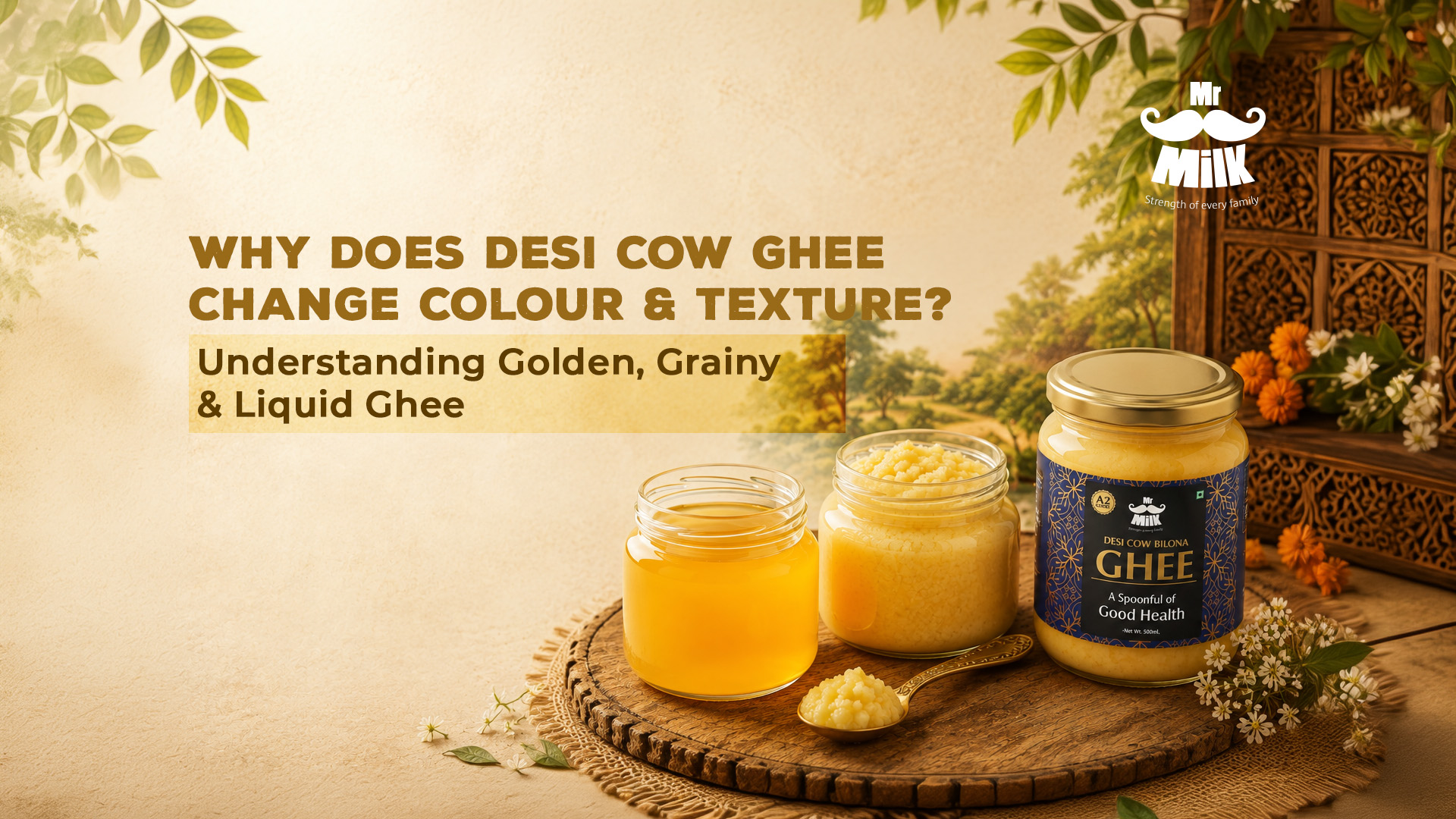
Why Does Desi Cow Ghee Change Colour & Texture? Understanding Golden, Grainy & Liquid Ghee
Summary:
Natural Desi Cow Ghee is a dynamic, living food product that naturally shifts in appearance based on environmental factors and production methods. Factors like room temperature, pasture forage, seasonal shifts, and traditional Bilona churning directly influence whether ghee appears golden, smooth, grainy (danedar), or fully liquid. Recognising these physical changes helps consumers distinguish genuine, unadulterated cow ghee from industrial, hydrogenated alternatives.
Key Highlights:
Natural Granulation (Danedar): Grainy texture forms when liquid fat cools slowly, allowing fatty acids like palmitic and stearic acid to crystallise naturally.
Seasonal Colour Shifts: Beta-carotene from fresh green grass gives summer ghee a richer golden hue, while dry winter feed results in a lighter yellow tone.
Temperature Sensitivity: Ghee has a complex melting range (around 28°C–36°C); it liquefies naturally in warm climates and solidifies in cooler environments without losing nutrients.
Sign of Pure Bilona Crafting: Unrefined ghee made using traditional curd-churning methods retains native fat structures, whereas industrially processed ghee remains artificially uniform.
Have you ever opened a jar of Desi Cow Ghee and wondered why one batch looks deep golden while another appears pale yellow? Or why some ghee develops a beautiful grainy texture while others remain smooth and liquid?
Many people assume that colour and texture indicate quality. In reality, natural variations in Desi Cow Bilona Ghee are often a sign of authenticity rather than inconsistency.
Understanding these changes can help you identify genuine ghee and make more informed choices for your family's health. Let's explore what causes these natural differences and why they are completely normal in traditionally prepared ghee.
What Determines the Colour of Desi Cow Ghee?
The colour of Desi Cow Ghee depends on several natural factors, including the breed of the cow, its diet, the season, and the production method.
1. The Cow's Diet Plays a Major Role:
The golden colour often comes from naturally occurring pigments called carotenoids found in green fodder and grass.
When Desi Cows consume:
Fresh green grass
Seasonal fodder
Natural farm-grown feed
Their milk contains higher levels of beta-carotene, which eventually contributes to the rich golden shade of ghee. Cows consuming different feed combinations may produce milk that results in lighter-coloured ghee without affecting quality or nutrition.
2. Breed of the Cow Matters:
Indigenous Indian breeds such as Gir Cows are known for producing milk rich in beta-carotene.
Unlike many exotic breeds that convert beta-carotene into vitamin A more efficiently, Indian breeds often retain more carotene in the milk fat. This is one reason why ghee made from the milk of Gir and other indigenous cows often displays a naturally golden appearance.
3. Seasonal Variations Affect Colour:
The colour of ghee can change throughout the year.
For example:
Monsoon and winter seasons often provide access to greener fodder.
Summer conditions may alter feed composition.
Changes in pasture quality influence milk fat characteristics.
As a result, genuine Bilona Ghee may naturally vary in colour from one season to another.
Why Does Desi Cow Ghee Become Grainy?
One of the most appreciated characteristics of traditional ghee is its grainy texture, often called "danedar" ghee.
The Grainy Texture Is a Sign of Traditional Processing
When prepared through the Traditional Bilona Method, milk is first converted into curd, churned to obtain makkhan (butter), and then slowly heated to produce ghee. During cooling, milk fat crystals begin forming naturally. When conditions are right, these crystals create the grainy texture many consumers prefer.
Factors That Influence Grain Formation
Slow Cooling: Gradual cooling allows fat crystals to develop properly, leading to a grainy structure.
Quality of Milk Fat: Milk from healthy Desi Cows often contains a balanced fat profile that supports natural grain formation.
Traditional Bilona Method: The slow, careful process used in Desi Cow Bilona Ghee production encourages natural crystallisation, unlike industrial methods that may prioritise speed.
Does Grainy Ghee Mean Better Quality?
Not necessarily.
While graininess is commonly associated with traditionally prepared ghee, both grainy and smooth ghee can be authentic and nutritious.
Texture alone should not be the sole factor used to judge quality.
Why Does Ghee Become Liquid?
Many consumers become concerned when their ghee turns completely liquid during summer.
The truth is simple: this is completely natural.
Temperature Directly Impacts Ghee
Ghee begins softening and melting when surrounding temperatures rise.
In warmer Indian climates:
Summer temperatures can liquefy ghee.
Indoor kitchen temperatures can affect consistency.
Seasonal fluctuations may cause repeated melting and solidification.
Liquid Ghee Is Not Spoiled Ghee
If stored properly and free from moisture contamination, liquid ghee remains perfectly safe and nutritious.
Whether your ghee is:
Solid
Semi-solid
Grainy
Fully liquid
Its nutritional value largely remains unchanged.
Why Does Genuine Bilona Ghee Show Natural Variations?
Commercially processed products often look identical throughout the year because manufacturers standardise production.
Traditionally prepared Bilona Ghee behaves differently. Authentic Ghee Reflects Nature.
Natural variations may occur in:
Colour
Aroma
Texture
Grain size
Consistency
These differences are influenced by:
Seasonal feed changes
Lactation cycles
Weather conditions
Regional farming practices
Rather than being defects, these changes often indicate that the product is minimally processed.
Does Desi Cow Ghee Contain A2 Protein?
This is one area where many consumers get confused.
Understanding A2 Protein and Ghee:
Milk from indigenous Indian breeds such as Gir Cows naturally contains predominantly A2 beta-casein protein. Research suggests that A2 beta-casein may be easier for some individuals to digest compared to A1 beta-casein because it is less likely to release a peptide called BCM-7 during digestion. Some people who experience discomfort with regular milk report better digestive comfort when consuming products derived from A2 milk.
Does Ghee Contain Significant Protein?
Ghee is almost entirely milk fat.
During the traditional preparation process:
Water is removed.
Most milk solids are separated.
Protein content becomes extremely low.
Therefore, while Desi Cow Bilona Ghee originates from milk containing A2 beta-casein, ghee itself contains negligible amounts of protein.
The greater focus should be on the quality of the milk source, traditional preparation methods, and purity of the final product.
What Are the Benefits of Desi Cow Ghee?
For generations, Indian households have valued ghee for both culinary and wellness purposes.
Some commonly appreciated Benefits of Desi Cow Ghee include:
Provides healthy fats for daily energy.
Supports absorption of fat-soluble vitamins.
Enhances flavour and aroma in cooking.
Contains naturally occurring butyric acid.
Suitable for high-heat cooking due to its stable fat composition.
Plays an important role in traditional Indian diets.
When prepared using the Traditional Bilona Method, the focus remains on preserving the natural characteristics of milk fat while maintaining authenticity.
How to Identify Genuine Desi Cow Bilona Ghee?
When choosing ghee for your family, look beyond colour alone. Consider:
✔ Source of milk from indigenous Desi Cows
✔ Traditional Bilona preparation
✔ Natural aroma
✔ Seasonal variations in texture
✔ Transparency about sourcing and production
✔ No unnecessary additives or artificial colouring
Authentic ghee is not always identical from batch to batch - and that's often a good sign.
Why Families Trust Mr. Milk Desi Cow Bilona Ghee?
At Mr. Milk, we believe traditional methods still matter.
Our Desi Cow Bilona Ghee is prepared using milk sourced from indigenous cows and crafted through the Traditional Bilona Method to preserve authenticity, flavour, and nutritional integrity.
We are committed to delivering premium-quality ghee directly to households with free shipping all across India, making it easier than ever to enjoy traditionally prepared ghee wherever you live.
Final Thoughts
The next time you notice your Desi Cow Ghee looking more golden, developing grains, or turning liquid, remember that these changes are often part of its natural character.
Colour variations reflect the cow's diet and season. Graininess develops through natural crystallisation. Liquidity simply reflects temperature changes.
Rather than searching for perfect uniformity, look for authenticity, traditional preparation, and trusted sourcing.
Order Authentic Desi Cow Bilona Ghee from Mr. Milk
Experience the richness of traditionally prepared Desi Cow Bilona Ghee made from indigenous cow milk and crafted using the time-honoured Bilona process.
Shop Mr. Milk Desi Cow Bilona Ghee today and enjoy free shipping all across India. Bring authentic goodness to your family's kitchen, one spoonful at a time.
Enjoyed this article?
Experience authentic Bilona-crafted A2 Desi Cow Ghee — made the traditional way, delivered fresh to your door.
Frequently Asked Questions
Author
Shradhaa S Gokhale
Traditional dairy experts specialising in authentic A2 Desi Cow Ghee made using the ancient Bilona process. Passionate about farm-to-table nutrition, Ayurvedic food wisdom, and supporting indigenous Indian cow breeds.
More from Mr. Milk