How Much Ghee Should You Eat in a Day? A Practical Guide for Everyday Cooking

Summary:
Ghee is packed with essential fatty acids and fat-soluble vitamins, but striking the right balance is key to reaping its wellness benefits. Most healthy adults can safely consume 1 to 2 tablespoons (15-30 ml) of ghee per day as part of a balanced diet. Using it mindfully in everyday cooking adds rich flavour and aids nutrient absorption without causing excess caloric intake.
Key Highlights:
Recommended Intake: 1-2 tablespoons daily is optimal for active, healthy adults.
Nutritional Edge: Rich in vitamins A, D, E, K, and butyric acid to support gut health.
High Smoke Point: Ideal for high-heat cooking like sautéing, searing, and roasting without burning.
Portion Balance: Adjust intake based on personal health goals, daily activity levels, and overall dietary fat intake.
Ghee has always had a special place in Indian kitchens. A spoonful over dal, a little in khichdi, ghee-roasted vegetables, or a warm roti brushed with ghee - these are simple food habits many of us grew up with.
But there is one question that often comes up:
How much ghee should you actually eat in a day?
The answer depends on your overall diet, energy needs, cooking habits, and how much visible fat you already get from other foods. Ghee can be part of a balanced diet, but like every concentrated source of fat, portion size matters.
For most healthy adults, around 1-2 teaspoons of ghee a day can be a practical starting point when it fits within their overall dietary fat intake. Some people may consume more depending on their calorie needs and the rest of their diet, while others may need less.
Let's understand how to use Desi Ghee sensibly in everyday Indian cooking.
How Much Ghee Should You Eat in a Day?
For a healthy adult, 1-2 teaspoons of ghee per day is a reasonable everyday portion to start with. However, there is no universal ideal quantity because your total fat intake matters more than ghee alone.
One teaspoon of ghee is approximately 5 grams and provides roughly 45 calories, primarily from fat. Two teaspoons provide approximately 90 calories.
Your daily intake can include ghee used for:
Cooking vegetables or dal
Tempering tadka
Applying to roti or paratha
Adding to khichdi or rice
Preparing traditional sweets
Other sources of visible fats, such as butter or cooking oils
So, if your meals already contain plenty of oil, butter, nuts, seeds, fried foods, or rich dairy products, you may not need additional ghee.
Is More Ghee Always Better?
No. Ghee is nutrient-dense, which means a small quantity provides considerable energy.
The goal isn't to consume as much ghee as possible. The goal is to use an appropriate amount that adds flavour and fits comfortably into a balanced diet.
This is particularly important for children, older adults, and people managing their calorie intake.
What Makes Desi Ghee Different?
Desi Ghee is a traditional Indian dairy fat made by separating butter from milk or curd and then clarifying it.
The quality of ghee depends on factors such as the milk source, preparation process, handling, and storage.
Traditional Indian ghee-making has historically involved converting milk into curd, churning the curd to obtain butter, and then heating the butter to produce ghee.
This is commonly referred to as the traditional bilona method.
What Is Desi Cow Bilona Ghee?
Desi Cow Bilona Ghee is ghee traditionally prepared from curd using the bilona process. The method involves culturing milk into curd, churning it to separate butter, and heating the butter to make ghee.
The term "bilona" refers to the traditional churning process.
When choosing Bilona Ghee, it is useful to look beyond the name and understand:
What type of milk is used?
Are Gir Cows or other Desi Cows the source?
Is the ghee prepared from curd rather than directly from cream?
Are ingredients clearly disclosed?
How is the product processed and stored?
These details tell you considerably more about the product than marketing claims alone.
What Are the Benefits of Desi Cow Ghee?
Ghee can contribute dietary fat and energy to meals, while also helping carry fat-soluble vitamins present in foods.
However, it is important not to treat ghee as a cure-all or assume that consuming more automatically provides more health benefits.
Some practical benefits of including a moderate amount of ghee in meals include:
1. It Adds Energy to Meals:
At approximately 9 calories per gram of fat, ghee is an energy-dense food. For people with higher energy requirements, a small amount can make meals more calorie-dense without significantly increasing their volume.
2. It Enhances Flavour:
A little ghee can make simple foods such as dal, khichdi, rice and vegetables more aromatic and satisfying. This is one reason ghee has remained a staple in Indian cooking for generations.
3. It Works Well for Cooking:
Ghee has a relatively high smoke point, commonly reported around 230°C (446°F), although the exact point can vary depending on its composition and processing.
This makes it suitable for many everyday cooking applications, including sautéing and tempering.
4. It Can Be Part of a Balanced Diet:
Dietary fat has an important role in the body, including helping with the absorption of fat-soluble vitamins.
The key is balance. Ghee should complement a diet containing vegetables, fruits, whole grains, pulses, dairy or suitable alternatives, nuts and seeds, rather than replacing these foods.
How Much Ghee Is Right for Different Meals?
You don't necessarily need to measure every teaspoon of ghee you eat. A simple approach is to think about where ghee adds the most value to your meal.
For example:
Food | Practical amount |
|---|---|
Dal tadka | ½–1 tsp |
Khichdi | ½–1 tsp |
Roti | ½ tsp |
Rice | ½ tsp |
Vegetable sauté | 1 tsp |
Cooking a family meal | Adjust according to total servings |
These are practical examples, not medical prescriptions. The amount should be adjusted according to the complete meal and individual dietary needs.
Is Bilona Ghee Healthy to Eat Every Day?
Yes, Bilona Ghee can be included in a balanced everyday diet in moderate portions. The traditional bilona method describes how the ghee is prepared; it does not mean that unlimited quantities are beneficial.
If you enjoy Bilona Ghee, use it as one of your dietary fat sources rather than adding it on top of an already high-fat diet.
For example, if your breakfast includes ghee, lunch contains an oil-based curry, and dinner includes butter or another rich food, your total visible fat intake may already be substantial.
What About Children?
Children need dietary fat as part of a balanced diet, but their needs vary according to age, growth, activity and overall food intake.
Instead of giving children large quantities of ghee because it is traditionally considered nourishing, focus on balanced meals with appropriate portions of grains, pulses, vegetables, fruits, dairy and healthy fats.
How Should You Choose Good Desi Cow Ghee?
Whether you're buying Desi Cow Bilona Ghee or another type of ghee, check the label carefully.
Look for:
Clearly stated ingredients
Transparent sourcing information
Clearly described preparation method
Appropriate packaging and storage instructions
A reliable manufacturer
No unnecessary additives
If you're specifically looking for Bilona Ghee, check whether the brand explains its traditional bilona method rather than simply using "bilona" as a product label.
Can You Cook With Ghee Every Day?
Yes, ghee can be used for everyday cooking as long as the quantity fits your overall dietary fat intake.
It works particularly well for tadka, roasting, sautéing and finishing dishes.
You don't need to replace every cooking oil in your kitchen with ghee. Using different fat sources appropriately can be a practical way to maintain variety while keeping overall intake in check.
How Mr. Milk Make Desi Cow Bilona Ghee?
At Mr. Milk, our approach to ghee focuses on traditional preparation and careful sourcing.
Our Desi Cow Bilona Ghee is made using milk from Desi Cows, including Gir Cows, and follows the traditional curd-to-butter-to-ghee process.
For families who want to include ghee in everyday Indian meals, the focus should ultimately be simple: know what you're buying, use an appropriate portion, and enjoy it as part of a balanced diet.
Mr. Milk offers Free Shipping across India, making it convenient to order Desi Cow Bilona Ghee for your home, wherever you are in the country.
Enjoyed this article?
Experience authentic Bilona-crafted A2 Desi Cow Ghee — made the traditional way, delivered fresh to your door.
FAQs:
The Bottom Line: How Much Ghee Should You Eat?
For most healthy adults, 1-2 teaspoons of ghee a day is a simple, practical range to consider, provided it fits within your overall dietary fat intake.
Whether you choose Desi Ghee, Desi Cow Bilona Ghee or another variety, moderation matters more than simply increasing consumption.
Choose a ghee with transparent sourcing and preparation, use it thoughtfully in your everyday meals, and let the rest of your diet do its part too.
Looking for traditionally prepared Desi Cow Bilona Ghee for your family?
Explore Mr. Milk's ghee range and enjoy Free Shipping across India.
Author
Shradhaa S Gokhale
Traditional dairy experts specialising in authentic A2 Desi Cow Ghee made using the ancient Bilona process. Passionate about farm-to-table nutrition, Ayurvedic food wisdom, and supporting indigenous Indian cow breeds.
More from Mr. Milk
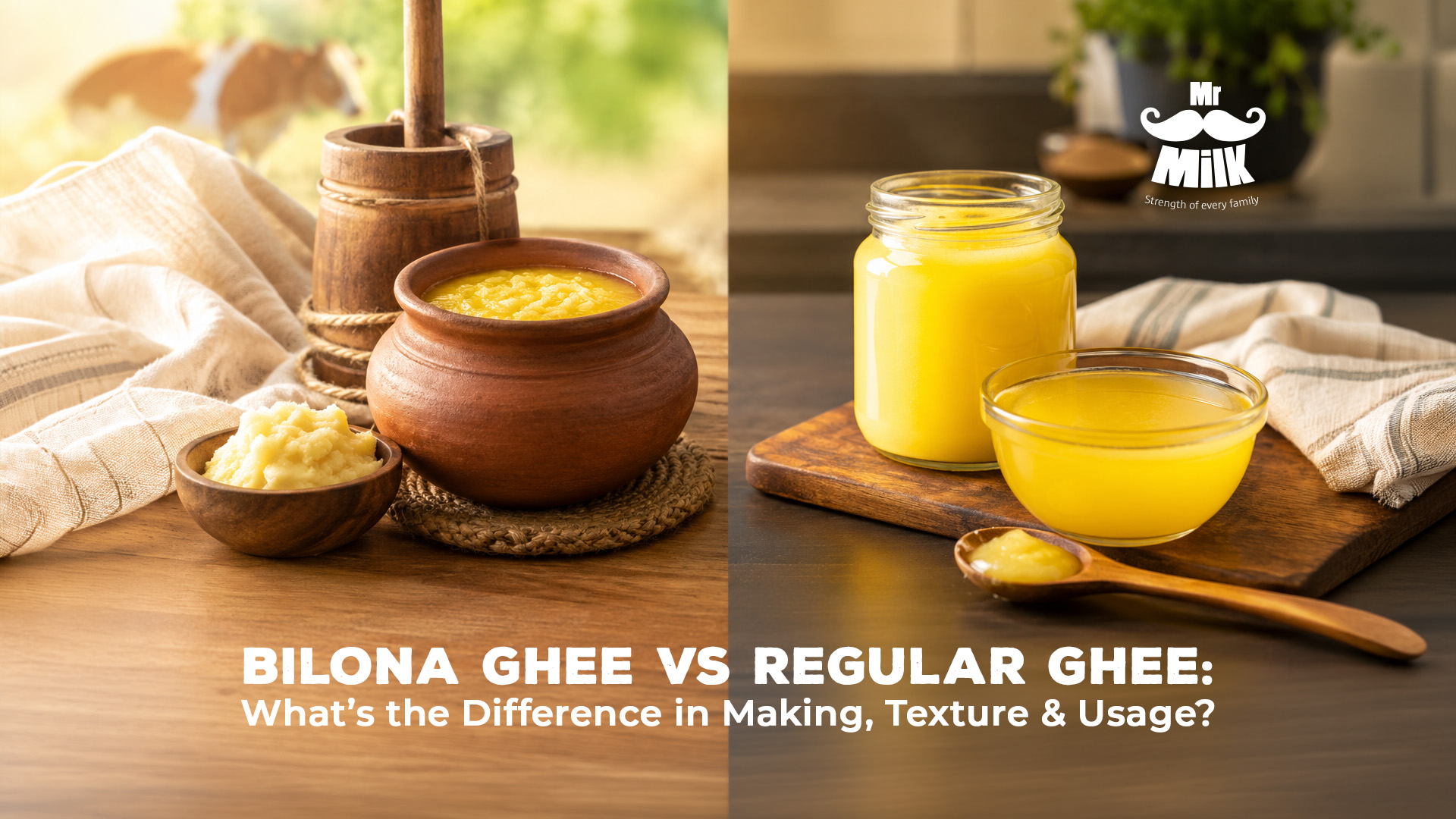
Bilona Ghee vs Regular Ghee: What’s the Difference in Making, Texture & Usage?
9 min read
Why Desi Cow Ghee Is a Must-Have in Traditional Indian Festive Cooking
9 min read

Why Does Desi Cow Ghee Change Colour & Texture? Understanding Golden, Grainy & Liquid Ghee
8 min read