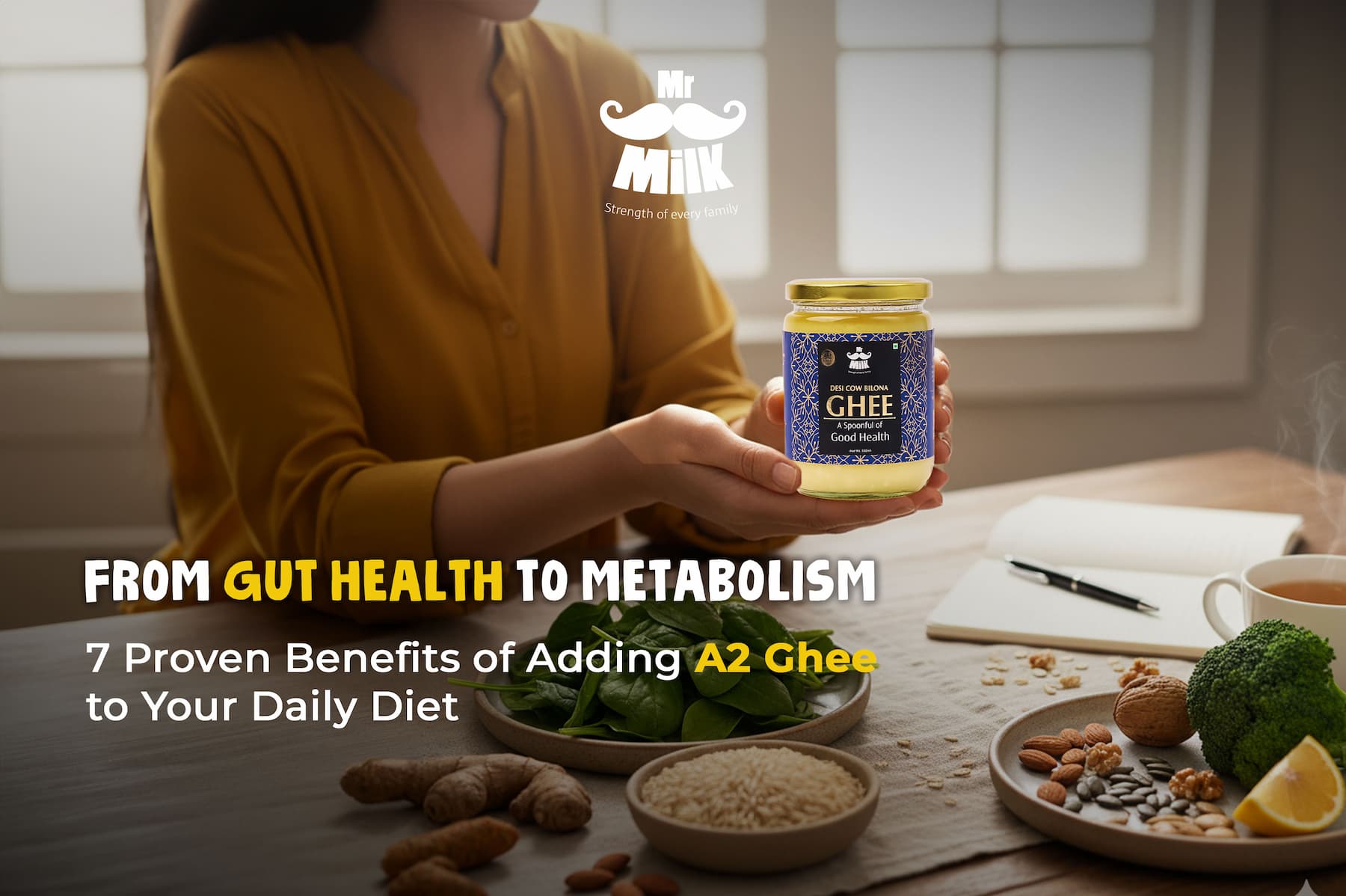
From Gut Health to Metabolism: 7 Proven Benefits of Adding A2 Ghee to Your Daily Diet
Summary:
Desi Cow Ghee is a traditional Indian cooking fat that provides energy, adds flavour to meals, and helps absorb fat-soluble vitamins. It contains fatty acids, including butyric acid, and can be used in a variety of everyday recipes. Desi Cow Ghee is best enjoyed in moderation as part of a balanced diet. Traditional Bilona Ghee is prepared by churning curd to separate butter, which is then gently heated to make ghee.
Key Highlights:
Desi Cow Ghee provides dietary fat and energy.
Dietary fat helps the body absorb vitamins A, D, E and K.
Ghee contains fatty acids, including butyric acid.
Traditional Bilona Ghee is prepared from curd, not directly from cream.
Mr. Milk prepares Desi Cow Bilona Ghee using milk from its own Gir and Sahiwal cows.
Desi Cow Ghee has been a familiar part of Indian kitchens for generations. From a spoonful added to warm dal and khichdi to the rich aroma it brings to homemade sweets, ghee has always had a special place in everyday Indian cooking.
But its role goes beyond flavour. Desi Cow Ghee is a source of dietary fat and energy, helps the body absorb certain fat-soluble vitamins from food, and adds richness to a variety of meals. When enjoyed in appropriate quantities as part of a balanced diet, it can be a versatile addition to everyday eating.
Today, many families are also paying closer attention to how their food is prepared and where it comes from. This has renewed interest in traditional Bilona Ghee, made using the time-honoured process of churning curd to obtain butter before preparing ghee.
Let's explore seven practical reasons to include Desi Cow Ghee in your daily diet and how to enjoy it thoughtfully.
1. Provides Energy for Everyday Activities:
Our bodies need energy to carry out everyday activities, from working and studying to exercising and managing household responsibilities. Dietary fats are one of the body's sources of energy, providing approximately 9 calories per gram.
Desi Cow Ghee is primarily composed of fat, making it an energy-dense ingredient. A small quantity can add richness and energy to a meal without requiring a large serving.
For example, adding a little ghee to dal, khichdi or roti can make a simple homemade meal more satisfying. It is one reason ghee has remained a familiar ingredient in traditional Indian food.
However, because ghee is calorie-dense, portion size matters. It is best enjoyed as part of an overall balanced eating pattern rather than added without considering your daily dietary needs.
2. Helps with the Absorption of Fat-Soluble Vitamins:
Did you know that some vitamins need dietary fat to be absorbed effectively by the body?
Vitamins A, D, E and K are known as fat-soluble vitamins. Unlike water-soluble vitamins, they are absorbed along with dietary fats during digestion.
Including a source of fat in meals containing these nutrients can support their absorption. Desi Cow Ghee is one option for adding dietary fat to everyday meals.
For instance, you can use a little ghee while preparing vegetables, dal or other home-cooked dishes. This combines the goodness of different food ingredients in one meal.
It is important to remember that ghee itself should not be considered a complete source of these vitamins or a substitute for a varied, nutrient-rich diet.
3. Adds Flavour and Makes Everyday Meals More Enjoyable:
One of the simplest reasons people love Desi Cow Ghee is its distinctive aroma and taste.
A little ghee can transform an ordinary meal into something comforting and familiar. Think of warm dal rice with a spoonful of ghee, soft rotis brushed with ghee or freshly prepared khichdi served with a little ghee on top.
It also works beautifully in traditional Indian recipes such as:
Homemade besan ladoos
Atta halwa
Moong dal halwa
Vegetable pulao
Parathas and chapatis
Traditional festive sweets
Beyond flavour, ghee brings a smooth texture and richness to food. This makes it a versatile ingredient for families who enjoy preparing traditional meals at home.
4. Contains Fatty Acids, Including Butyric Acid:
Ghee contains different types of fatty acids, including a small amount of butyric acid, a short-chain fatty acid.
Butyrate is also produced naturally in the large intestine when gut bacteria ferment dietary fibre. It plays an important role in intestinal biology and is a subject of ongoing nutritional research.
This is one reason butyric acid is often discussed in conversations about gut health.
However, it is important to understand the distinction: the presence of butyric acid in ghee does not establish that eating ghee improves digestion, treats gut problems or reduces inflammation throughout the body.
You can enjoy Desi Cow Ghee as part of a varied diet that also includes fibre-rich foods such as vegetables, fruits, whole grains, pulses and legumes. These foods support a balanced approach to everyday nutrition.
5. Offers Versatility in Everyday Indian Cooking:
A good kitchen ingredient is one that fits naturally into different meals. Desi Cow Ghee is particularly versatile because it can be used in a variety of traditional cooking preparations.
Here are some simple ways to include it in your daily routine:
For breakfast: Add a little ghee to homemade parathas, poha or upma.
For lunch: Use it as a finishing touch for dal, rice or khichdi.
For evening meals: Add it to freshly prepared rotis or use it in vegetable preparations.
For dinner: A small amount can enhance the taste of homemade pulao or a comforting bowl of khichdi.
For festive cooking: Use it in traditional sweets, ladoos, halwa and other celebratory recipes.
Its versatility makes it easy to enjoy traditional flavours without making major changes to your everyday cooking habits.
6. Brings Traditional Bilona Preparation into Modern Kitchens:
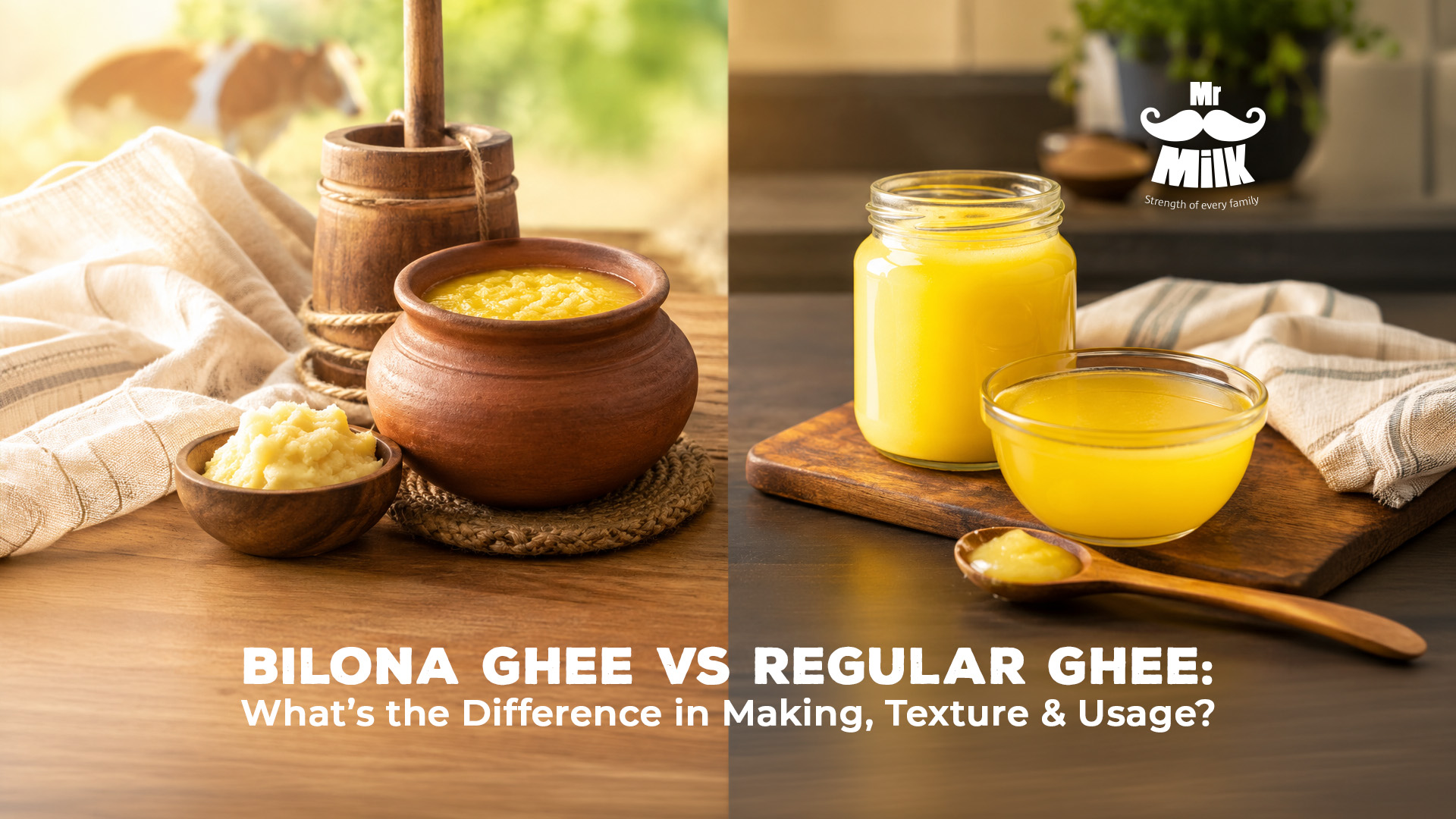
The way ghee is prepared is an important part of its identity. Traditional Bilona Ghee is made using a process that begins with curd rather than directly processing cream into ghee.
The traditional preparation involves three main stages:
Preparing curd: Milk is first converted into curd.
Churning the curd: The curd is traditionally churned to separate butter.
Preparing ghee: The separated butter is gently heated until it becomes ghee.
This curd-to-butter-to-ghee process is known as the Bilona method. It is valued for its traditional preparation and the characteristic aroma, flavour and texture of the resulting ghee.
For families who appreciate traditional food practices, Bilona Ghee brings a familiar method of preparation into modern kitchens.
7. Makes Traditional Food an Enjoyable Part of Family Meals:
Food is not just about nutrients. It is also about family traditions, familiar flavours and the memories created around the dining table.
In many Indian homes, ghee is associated with comforting meals prepared with care. It may be added to a child's khichdi, served with homemade dal rice or used to prepare festive sweets shared with family and friends.
These everyday food traditions are one reason Desi Cow Ghee continues to have a place in Indian kitchens.
You can enjoy it in different ways depending on your family's preferences and dietary requirements. The key is to combine it with a variety of nutritious foods and use an appropriate quantity.
What Makes Mr. Milk Desi Cow Bilona Ghee Special?
At Mr. Milk, we believe that good food begins with thoughtful sourcing and preparation.
Our Desi Cow Bilona Ghee is prepared using milk from indigenous Gir and Sahiwal cows raised on our own farm near Lonavala, Maharashtra.
Our traditional preparation follows the Bilona method, where milk is first converted into curd, the curd is churned to obtain butter, and the butter is gently heated to prepare ghee.
We focus on small-batch preparation and a process rooted in traditional Indian food practices.
From the farm where our cows are raised to the preparation of our Desi Cow Bilona Ghee, we value knowing where our dairy products come from and how they are made.
For families who appreciate the flavour and tradition of Desi Cow Ghee, Mr. Milk brings this familiar kitchen essential to everyday meals.
How Much Desi Cow Ghee Should You Include in Your Diet?
There is no single daily quantity that suits everyone. Your overall diet, activity level, health requirements and total saturated fat intake all matter.
Ghee is rich in saturated fat, so it is important to enjoy it in moderation. If you are monitoring your cholesterol levels or have been advised to limit saturated fat, speak with your healthcare professional or registered dietitian about an appropriate quantity.
A balanced diet should include a variety of food groups, including vegetables, fruits, whole grains, pulses, nuts, seeds and suitable sources of protein.
The idea is not to add more ghee simply because it is traditional, but to enjoy it thoughtfully as one of the ingredients in a varied diet.
Ready to experience the pure, traditional taste and incredible health benefits of real A2 Ghee?
Enjoyed this article?
Experience authentic Bilona-crafted A2 Desi Cow Ghee — made the traditional way, delivered fresh to your door.
FAQs:
Bring the Tradition of Desi Cow Bilona Ghee to Your Kitchen
From everyday dal and rice to homemade parathas and festive sweets, Desi Cow Ghee remains a much-loved ingredient in Indian kitchens.
Its flavour, versatility and traditional preparation make it a familiar choice for families who appreciate the food traditions they have grown up with.
At Mr. Milk, we bring you Desi Cow Bilona Ghee prepared using milk from our own Gir and Sahiwal cows and a traditional curd-based Bilona process.
Explore Mr. Milk Desi Cow Bilona Ghee and bring the richness of traditional ghee preparation to your family's everyday meals.
Author
Mr. Milk Team
Traditional dairy experts specialising in authentic A2 Desi Cow Ghee made using the ancient Bilona process. Passionate about farm-to-table nutrition, Ayurvedic food wisdom, and supporting indigenous Indian cow breeds.
More from Mr. Milk