Bilona Ghee vs Regular Ghee: What’s the Difference in Making, Texture & Usage?
Summary:
Bilona Ghee and regular ghee differ primarily in their production methods. Traditional Bilona Ghee follows a curd-to-butter-to-ghee process, which can influence its texture, aroma and flavour. This guide explains how both types are made, how they can be used in everyday cooking, and what to consider when buying Desi Cow Ghee.
Key Highlights:
Traditional Bilona Method: Understand how milk is converted into curd, churned into butter and slowly transformed into ghee.
Texture & Aroma: Learn why Bilona Ghee can have a naturally grainy texture and distinctive buttery aroma.
Everyday Cooking: Discover how Bilona Ghee and regular ghee can be used for tadka, dal, rice, roti, paratha, sweets and more.
Choosing Ghee: Know what to check beyond the label, including milk source, manufacturing process, ingredients and storage.
Walk into an Indian kitchen, and you’ll probably find a jar of ghee somewhere nearby. It goes into dal, khichdi, parathas, sweets, tadkas and sometimes even a warm bowl of rice.
But not every ghee is made in the same way.
You may have noticed terms such as Bilona Ghee, Desi Cow Ghee, traditional bilona method and regular ghee on product labels. The difference is not simply about the type of cow or the price. It starts much earlier-with how the milk is transformed into ghee.
So, what exactly makes Bilona Ghee different from regular ghee? How is it made, why can its texture and aroma vary, and which cooking methods suit each type?
Let’s break it down simply.
What is the difference between Bilona Ghee and regular ghee?
The biggest difference is the process used to make the ghee.
Traditional Bilona Ghee is made by first converting milk into curd, churning the curd to separate butter, and then heating that butter to make ghee.
Regular ghee may be produced using different processes, commonly starting with cream or butter and then clarifying it.
Here’s the basic distinction:
Feature | Bilona Ghee | Regular Ghee |
|---|---|---|
Starting point | Milk → curd → butter | Often cream or butter |
Traditional process | Uses the traditional bilona method | Usually uses a more streamlined process |
Churning | Curd is traditionally churned to separate butter | Not necessarily churned from curd |
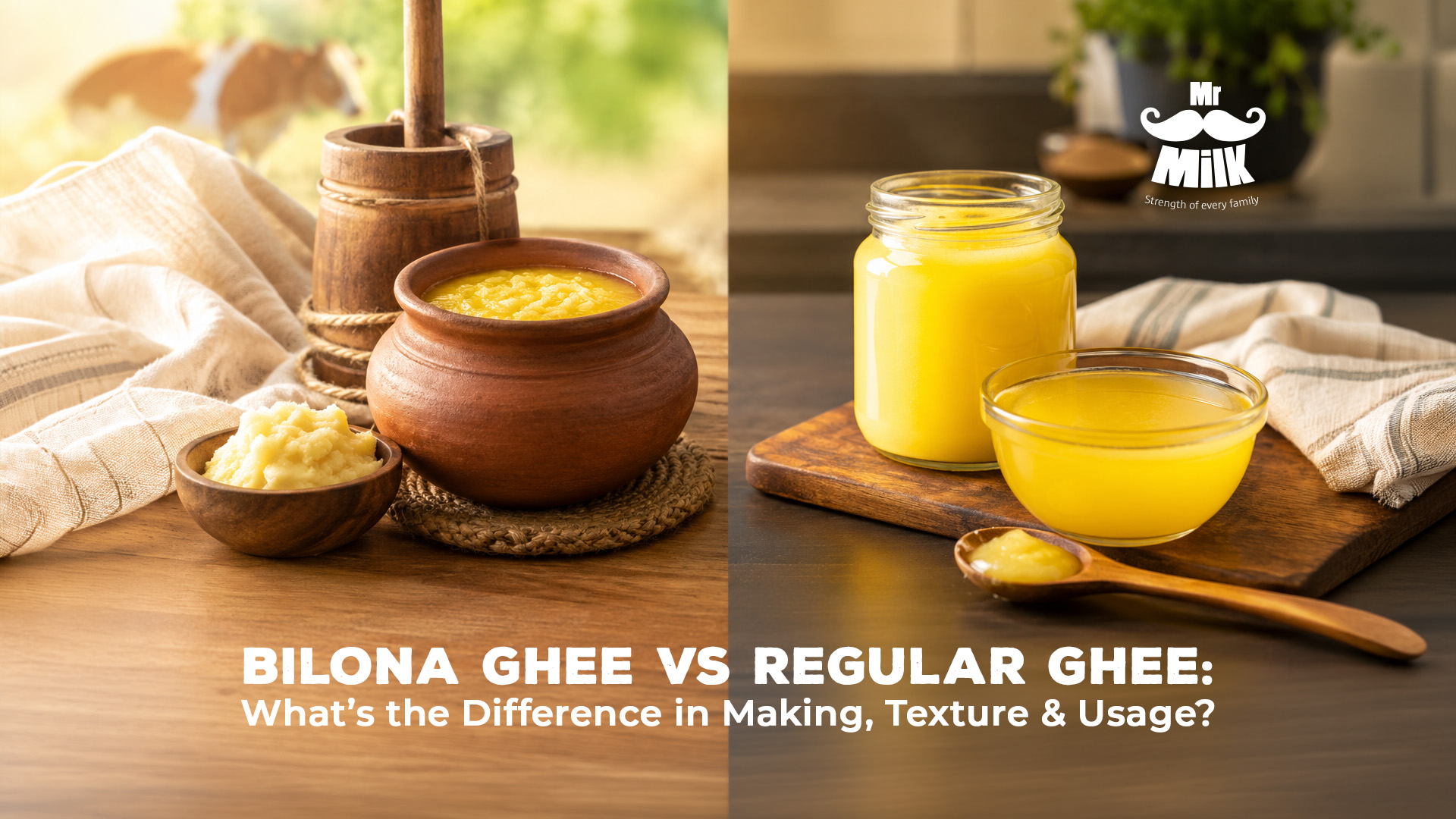
Texture | Often grainy or slightly granular | Usually smooth and uniform |
Aroma | Rich, buttery and traditionally pronounced | Can range from mild to pronounced |
Everyday use | Cooking, tadka, dals, rice, sweets | Cooking, frying, baking and everyday recipes |
Neither name alone tells you everything about the quality of the final ghee. The milk source, hygiene, processing, storage and manufacturing practices also matter.
How is Bilona Ghee made traditionally?
The defining feature of Bilona Ghee is the traditional bilona method.
It is a multi-step process that takes more time than simply clarifying cream or butter. Here is how the traditional process works.
1. Milk is collected:
The process begins with fresh milk. For Desi Cow Bilona Ghee, the milk comes from indigenous Desi Cows such as Gir Cows and other suitable indigenous breeds.
The quality and handling of the milk at this stage are important because the ghee ultimately reflects the raw material used to make it.
2. Milk is converted into curd:
Instead of separating cream directly from the milk, the traditional process involves setting the milk into curd.
The milk is allowed to ferment naturally with a suitable culture, resulting in curd. This is an important step because Bilona Ghee follows a curd-to-butter-to-ghee route.
3. Curd is churned to separate butter:
This is where the traditional bilona method gets its name.
The curd is churned using a traditional churning process. The movement causes the fat globules to come together, allowing butter to separate from the buttermilk.
The separated butter is then collected.
4. Butter is heated to make ghee:
The freshly separated butter is slowly heated.
As it warms, its water content evaporates while the milk solids separate and settle. The remaining golden fat is carefully filtered to obtain ghee.
This is why traditional Bilona Ghee involves several stages before the finished product reaches your kitchen.
Why does Bilona Ghee have a different texture?
Texture is one of the easiest differences to notice between traditionally made Bilona Ghee and many regular ghees.
Bilona Ghee can develop a slightly grainy, granular or crystalline texture, particularly when stored at cooler room temperatures.
Regular ghee is often smoother and more uniform, depending on how it has been processed, filtered and stored.
Interestingly, ghee texture can change with temperature. Ghee may be softer in warm weather and become more solid or grainy in cooler conditions.
So, a grainy texture is not automatically a sign of adulteration or spoilage. Likewise, a perfectly smooth texture does not necessarily indicate inferior quality.
The making process, temperature and storage conditions all influence the final texture.
How does Bilona Ghee taste and smell different?
The next noticeable difference is aroma.
Because traditional Bilona Ghee goes through the curd and butter stages, it can have a distinctive buttery, cooked-milk aroma with a richer sensory profile.
Regular ghee can also have a pleasant aroma, but its flavour profile depends on the raw material and manufacturing method used.
For many Indian families, this difference becomes particularly noticeable when ghee is added to simple foods such as:
Dal and rice
Khichdi
Roti or paratha
Vegetable preparations
Pongal
Halwa and other Indian sweets
Tempering for curries and dals
Sometimes, a spoonful of fragrant ghee is all a simple meal needs.
Is Bilona Ghee better than regular ghee?
There is no simple “better” answer because the two can differ mainly in how they are made, not just in their names.
Bilona Ghee follows a traditional, more involved process from curd to butter to ghee. Regular ghee may be produced through a more direct cream- or butter-based process.
If your priority is traditional preparation and the experience of traditionally churned ghee, Bilona Ghee may be the style you prefer.
If your priority is an everyday cooking fat with a familiar flavour and smooth consistency, regular ghee can also be practical.
The important thing is to look beyond the front label and understand the source, ingredients, manufacturing process and storage practices.
Can you use Bilona Ghee for everyday cooking?
Yes. Bilona Ghee can be used for many of the same everyday cooking applications as regular ghee.
Its relatively high smoke point makes ghee useful for sautéing, tadka and several Indian cooking methods. However, cooking temperature and duration still matter, and there is no need to heat any cooking fat beyond what the recipe requires.
Try Desi Cow Ghee for:
Tadka: Add a small spoonful to dal, khichdi or kadhi.
Roti and paratha: Spread a little over freshly cooked bread.
Rice: Mix into hot rice with dal or vegetables.
Sautéing: Use it for suitable vegetables and Indian preparations.
Sweets: Ghee is traditionally used in halwa, ladoos and several festive recipes.
Breakfast: Add a little to dishes such as poha, upma or paratha where it complements the recipe.
For everyday meals, portion matters more than simply choosing one type of ghee. Ghee is calorie-dense, so it is best enjoyed as part of a balanced diet.
What should you look for when buying Desi Cow Ghee?
If you are looking for the best Desi Cow Ghee in India for your household, don't choose based only on words such as “traditional” or “premium”.
Check:
Milk source: Look for clearly stated sourcing and indigenous breeds where relevant.
Manufacturing method: Understand whether it is made using the traditional bilona method.
Ingredients: A straightforward ingredient list is preferable.
Processing: Look for clear information about how milk becomes butter and then ghee.
Packaging: Proper packaging helps protect ghee from moisture, contamination and unwanted odours.
Brand transparency: A trustworthy brand should be comfortable explaining its sourcing and production process.
At Mr. Milk, our Desi Cow Bilona Ghee follows the traditional curd-to-butter-to-ghee approach, bringing an age-old preparation style into modern Indian kitchens.
And because good food should be accessible beyond one city, Mr. Milk offers Free shipping on all orders across India.
Enjoyed this article?
Experience authentic Bilona-crafted A2 Desi Cow Ghee — made the traditional way, delivered fresh to your door.
FAQs:
Bring Traditional Bilona Ghee to Your Kitchen
If you appreciate traditional Indian food-making practices and want to experience ghee made through the traditional bilona method, explore Mr. Milk Desi Cow Bilona Ghee.
From its curd-to-butter-to-ghee preparation to its distinctive texture and aroma, it brings a traditional approach to a staple that Indian families have enjoyed for generations.
Explore Mr. Milk Desi Cow Bilona Ghee today- with free shipping on all orders across India.
Author
Shradhaa S Gokhale
Traditional dairy experts specialising in authentic A2 Desi Cow Ghee made using the ancient Bilona process. Passionate about farm-to-table nutrition, Ayurvedic food wisdom, and supporting indigenous Indian cow breeds.
More from Mr. Milk