How to Choose the Best A2 Ghee? 7 Questions Every Buyer Should Ask

Summary:
This guide empowers health-conscious consumers to navigate the crowded A2 ghee market with confidence. By breaking down the crucial differences in cattle breeds, feeding practices, and processing techniques like the traditional Bilona method, it equips buyers with seven practical questions to verify purity, authenticity, and nutritional value before purchasing.
Key Highlights:
Breed & Sourcing Verification: How to confirm the ghee comes strictly from indigenous Indian cow breeds (like Gir or Sahiwal) known for A2 beta-casein protein.
Extraction Method Matters: Why traditional Bilona (churning curd) creates far superior, nutrient-dense ghee compared to commercial cream-based methods.
Feed & Farming Standards: The critical impact of grass-fed, pasture-raised cows on the flavour, aroma, and fatty acid profile of the final product.
Spotting Fake Labels: Essential tips to decipher misleading packaging and demand transparency on lab testing, additives, and purity.
If you’ve walked down the dairy aisle lately or scrolled through your favourite grocery app, you’ve probably noticed a massive shift. A product that our grandparents used every single day is suddenly the star of the modern wellness world: A2 Desi Cow Ghee.
But as demand has skyrocketed, so has the confusion. Walk into any Indian kitchen, and parents are asking the same question: With dozens of jars claiming to be "pure," "organic," and "traditional," how do you actually separate marketing fluff from genuine health food?
Choosing the right ghee isn’t just about flavour; it’s about what you’re putting into your family’s bodies. To help you cut through the noise, here are the 7 critical questions you should ask before buying your next jar of A2 Ghee.
7 Questions Every Buyer Should Ask Before Choosing A2 Ghee
1. Which Breed of Cow Does the Milk Come From?
The foundation of any great ghee is the DNA of the cow. True A2 Desi Cow Ghee must come exclusively from native Indian cattle breeds - such as Gir Cows, Sahiwal, Kankrej, or Tharparkar.
Unlike Western Holstein-Friesian (HF) or Jersey cows, which produce A1 beta-casein protein, our native Desi Cows naturally produce 100% A2 beta-casein protein. This protein structure is vastly different and aligns perfectly with the human digestive system, making it much easier on the stomach.
2. Is It Made Using the Traditional Bilona Method?
Many commercial brands use modern industrial shortcuts, spinning cream at high speeds in giant factories to quickly extract fat. This strip-mining process destroys the delicate nutrients.
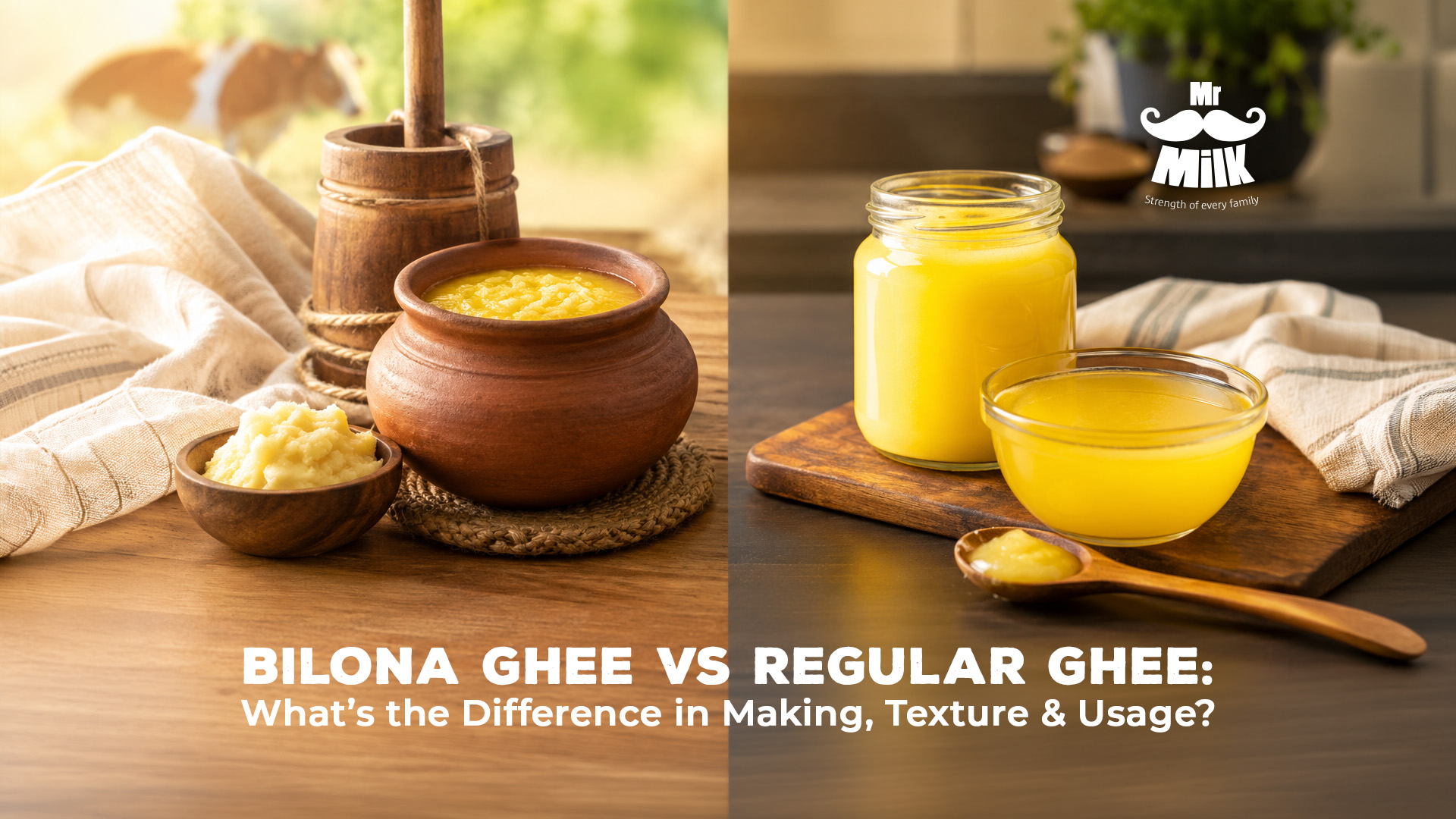
Authentic A2 Ghee relies on the ancient, labour-intensive traditional bilona method.
Raw A2 Milk: The process begins strictly with fresh, unpasteurized milk from indigenous Indian cow breeds (like Gir or Sahiwal). Their milk contains only the A2 beta-casein protein - which is naturally gentler on digestion than the A1 protein found in hybrid breeds.
Boiled & Cultured into Curd: The raw milk is gently boiled over a slow flame, cooled, and mixed with a starter culture overnight. This ferments the entire milk into rich, whole-milk curd (dahi), rather than skimming the cream off raw milk like modern industrial methods do.
Churned with Wooden Bilona: The curd is churned bidirectionally (clockwise and counter-clockwise) using a traditional wooden churner called a bilona. This natural friction separates fat solids into fresh white butter (makkhan), leaving buttermilk behind.
Makkhan Simmered on Slow Fire: The makkhan is simmered in a pot over low heat. As water evaporates and milk solids settle, the clear golden liquid that remains is filtered to produce aromatic, granular A2 ghee.
This slow, thoughtful process preserves the short-chain fatty acids and fat-soluble vitamins that give ghee its medicinal properties.
3. Are the Cows Allowed to Free-Grange and Graze?
What the cow eats directly determines the nutritional profile of your ghee. When cows free-range and graze on natural pasture, they consume seasonal grasses and medicinal herbs.
This grass-fed diet naturally elevates the levels of Conjugated Linoleic Acid (CLA) and Omega-3 fatty acids in the milk. If the cows are tied up in dark sheds and fed artificial grain pellets, the resulting ghee loses its vibrant golden hue and its therapeutic value.
4. Is the Ghee Made from Whole Curd or Direct Cream?
This is the hidden detail that trips up most buyers. Commercial ghee is typically made by separating cream from milk and boiling it down instantly. It’s fast, cheap, and yields more product.
However, true health benefits come from Cultured A2 Ghee. The milk must first be turned into whole curd using a natural starter culture, left to set overnight, and then churned. This fermentation process introduces gut-friendly properties and breaks down any trace proteins, making the final product completely lactose-free and incredibly digestion-friendly.
5. What Does the Texture and Aroma Tell You?
You don't always need a laboratory to test purity; your senses are excellent indicators.
The Texture: High-quality A2 ghee should have a distinct, granular (daanedar) texture. This happens naturally when the specific fatty acids cool at varying rates. If a jar is perfectly smooth like vegetable shortening, it's a red flag.
The Aroma: It should have a rich, nutty, and comforting aroma that takes you right back to your grandmother’s kitchen. A flat, chemical, or overly pungent smell indicates over-processing or artificial flavouring.
6. Is the Brand Completely Transparent About Its Sourcing?
Many brands function as aggregators - they buy bulk milk or white-label ghee from hundreds of unverified farms, blend it together, and paste their logo on the jar. There is zero quality control.
Look for brands that own their farms or work directly with single-source, ethically managed pastures. You deserve to know exactly how the cows are treated, what they are fed, and where the milk is processed.
7. Are There Any Added Preservatives or Artificial Colours?
Pure ghee is naturally shelf-stable and can last for months - even years - without refrigeration. If you check a label and spot preservatives, artificial colours, or stabilisers, put it back. True A2 ghee needs absolutely nothing added to it. Its beautiful golden colour and long shelf life are entirely natural results of the traditional simmering process.
The Mr. Milk Difference: Purity You Can Trust
At Mr. Milk, we didn't want to create just another dairy brand; we wanted to bring back the absolute purity of old-school Indian farming.
Our A2 Desi Cow Ghee is crafted exclusively from the milk of our loved, free-grazing Gir Cows at our state-of-the-art, single-source farm. We strictly follow the traditional bilona method - turning the nutrient-rich A2 milk into curd, churning it clockwise and counter-clockwise with wooden churns, and gently melting the butter to give you that perfect, aromatic daanedar texture.
Everyday Wellness: From boosting your child's immunity and brain development to lubricating joints and improving skin health, a spoonful of Mr. Milk A2 Ghee is pure daily nourishment.
Getting premium health choices shouldn't be a logistical hassle. Whether you are cooking in Mumbai, Delhi, Bengaluru, or any corner of the country, Mr. Milk offers Free shipping all across India, delivering pure wellness straight from our farm to your doorstep.
Enjoyed this article?
Experience authentic Bilona-crafted A2 Desi Cow Ghee — made the traditional way, delivered fresh to your door.
Frequently Asked Questions:
Give Your Family the Gift of Authentic Health
Ready to taste the difference that absolute purity makes? Elevate your daily meals with the rich aroma, flawless texture, and deep nourishment of traditionally made ghee.
Order Your Jar of Mr. Milk Pure A2 Bilona Ghee Today – Enjoy Free Shipping Across India!
Author
Shradhaa S Gokhale
Traditional dairy experts specialising in authentic A2 Desi Cow Ghee made using the ancient Bilona process. Passionate about farm-to-table nutrition, Ayurvedic food wisdom, and supporting indigenous Indian cow breeds.
More from Mr. Milk